Overview
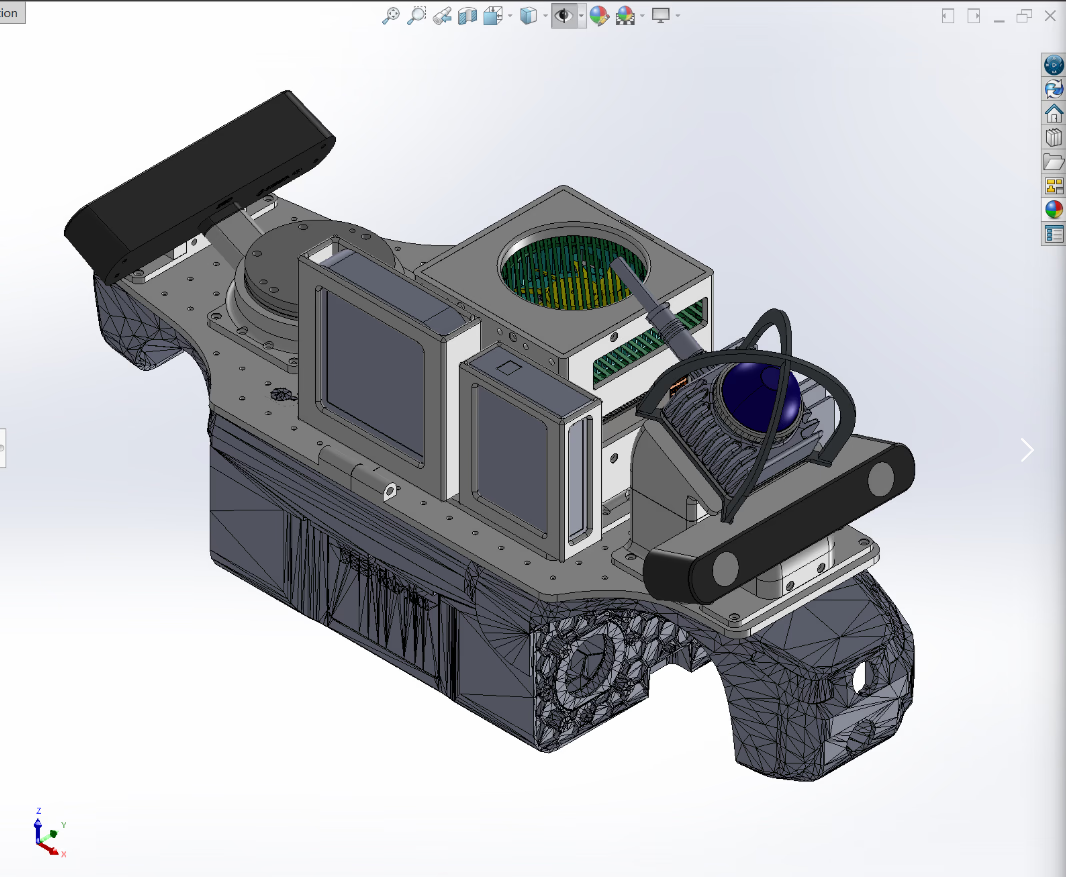
Custom payload system designed for the Deep Robotics Lite3 quadruped, developed for the UTS Robotics Institute Guide Dog Project.
In Operation
Walk Test
Run Test
Twist Jump & Moonwalk
Twist Jump & Pivot
Details
DMMS (Autumn 2026) · Distinction
Payload design for the Deep Robotics Lite3, a quadruped deployed as a guide dog platform for the UTS Robotics Institute. The perception payload integrates stereo vision, LiDAR, an onboard compute module, and a force/torque sensor on a custom 3D-printed structure. Developed with the Paw Pilot team, I owned the analytical and electrical side of the project (everything but CAD), and these calculations set the foundation for what the platform can safely carry and how it can be operated.
My Contributions
Material and FDM Analysis
- Structural material selection, evaluating candidate FDM polymers on UV stability, stiffness, thermal performance, and creep resistance for outdoor deployment
- Infill pattern and density selection, trading peak strength for mechanical isotropy and progressive failure under multi-directional gait loads
- Calibrated effective-property model fit to printed ground-truth specimens to predict part mass and strength across candidate materials
- Fastener interface review and a machined-polymer upgrade path for production durability
Structural and Stability Calculations
- Baseplate bending analysis confirming the structure meets the required safety factor with margin
- Bracket cantilever analysis sizing sections to satisfy stress and deflection criteria for sensor pointing accuracy
- Static stability study covering longitudinal and lateral tip-over, friction limits, and baseplate resonance against the gait excitation band
- Handle and transport load analysis across critical load cases for sensor-mount and fastener sizing
Motor Torque Analysis
- Joint-torque model across all four limbs using the official SDK kinematics, identifying the binding actuator constraint
- Operating-limit characterisation of where payload mass and terrain push the actuators past their continuous ratings, driving gait and payload recommendations
- Payload-versus-slope design envelopes defining safe gait and terrain limits across the payload range
Electrical
- Full payload power budget and runtime estimate, confirming operation within the onboard regulator limit
- Per-rail current analysis within bus limits
- Complete wiring and connector reference, including a custom sensor cable pinout and crimp procedure
- Custom connectors built to power and interface the payload components onto the platform’s power and data buses
Tooling
- Modular Python analysis scripts and shared-config notebooks, reusable as the design and active research evolve